
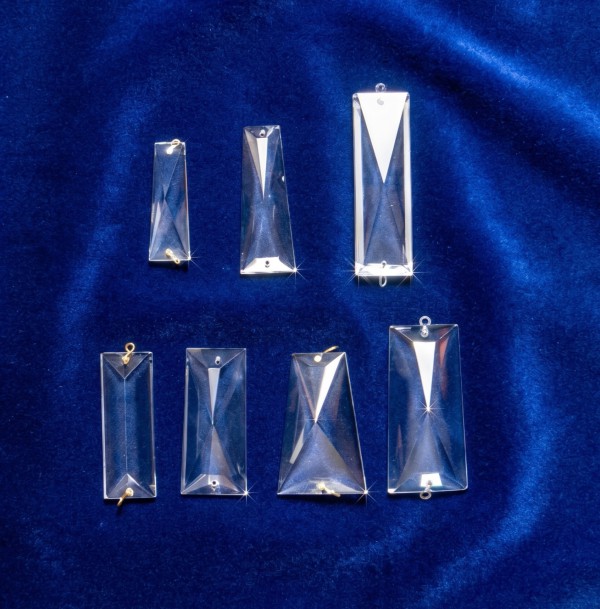
Originating in 18th and 19th-century Europe, coffin drops (also known as coffin prisms) became a signature element of classic chandelier design during the Georgian, Victorian, and French Empire eras. Named for their distinctive tapered, geometric silhouette reminiscent of traditional coffin cuts, these drops feature precision-cut angled facets that draw light inward and refract it into brilliant, shimmering rays.
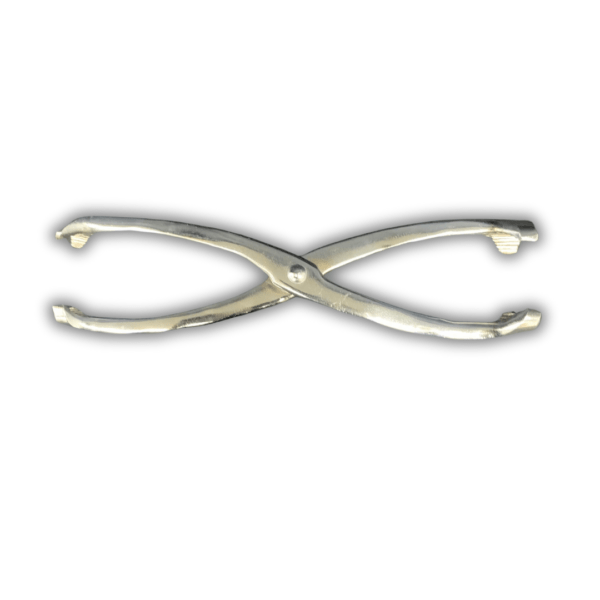
Used to remove shade rings from lamp / bulb holders with ease. Can be used on BC, SBC, ES and SES.
Slimline and 21cm long for accessing those hard to reach holders.
Larger end for gripping BC and ES and the smaller for SBC and SES.
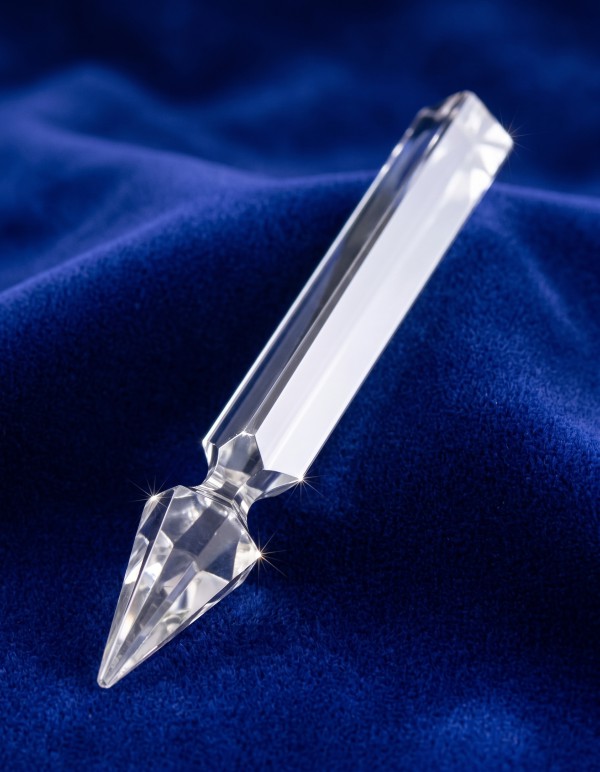
A Plain Albert (also called a Plain Albert drop or prism) is a distinct style of traditional crystal chandelier drop named after Prince Albert during the Victorian era.
We have hundreds of stylesna sizes
Late Georgian and Regency Periods (c. 1780–1830) heavy geometric facet-cutting style as a characteristic of the English Regency period. During this era, chandeliers shifted away from solid glass stems and toward brass frames dressed in cascading chains of graduated lead crystal
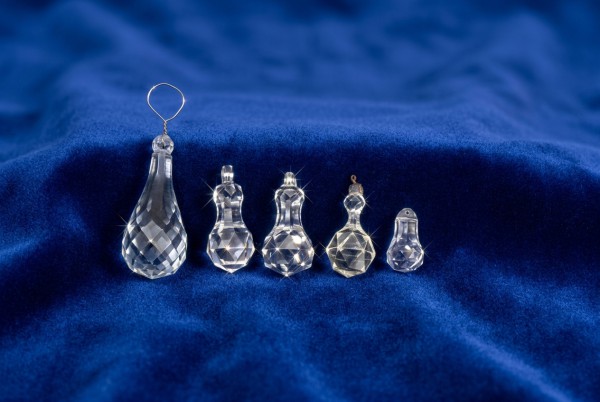
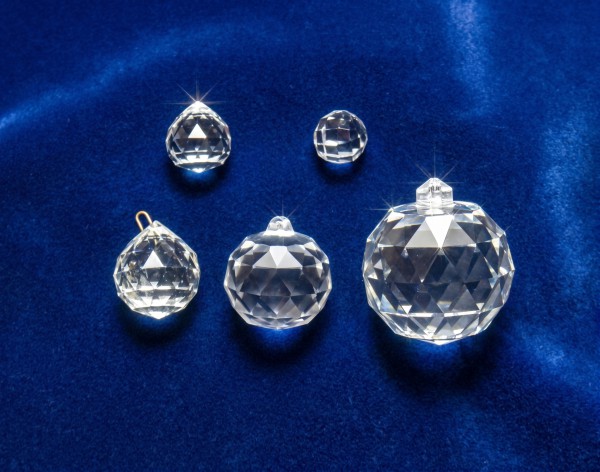
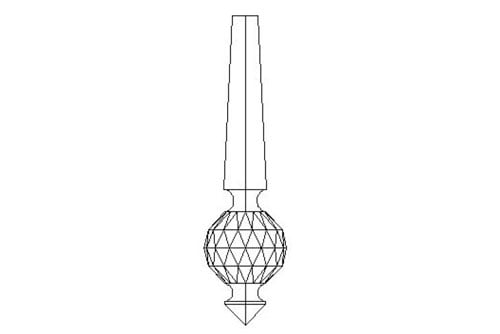
Knob Drop also known as an Hourglass Prism, emerging during the late 18th century and reaching peak popularity in Victorian and Edwardian lighting, knob drops feature a distinctive waist or cinched “neck” separating a small top cap from a plump, heavy faceted bulb base.
Crafted through precision lapidary cutting, the multi-faceted, teardrop-to-hourglass silhouette was engineered to maximize light collection in three dimensions, catching candlelight from surrounding tiers and scattering bright, multi-directional flashes.
These weighted, solid-glass drops were frequently suspended as terminal finials at the bottom centre of chandelier baskets, on hanging gasolier bases, or along the lower drops of elaborate parlour candelabras and mantel lusters.
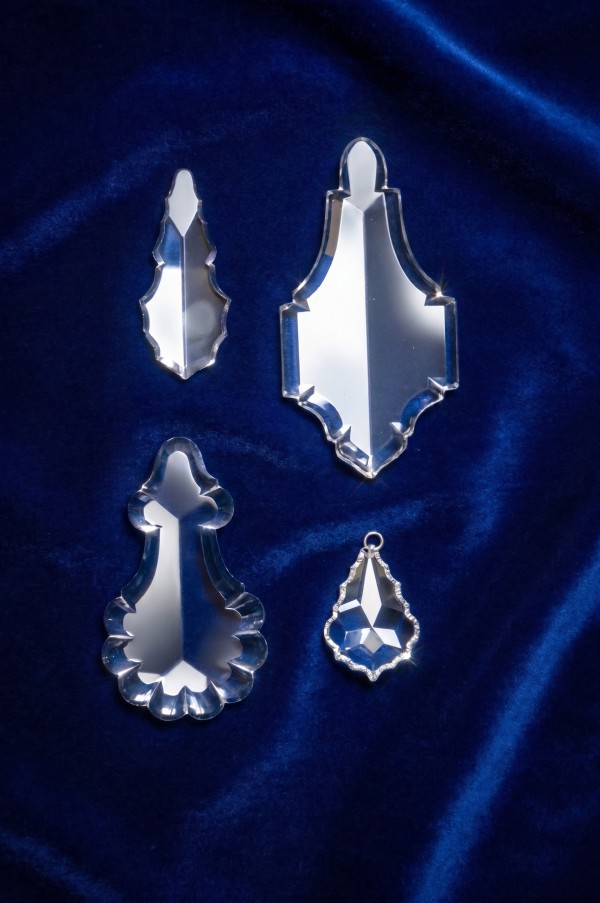
Add vintage elegance with these exquisite, authentic French Slab crystal prisms often shaped like leaves. Historically used in grand 18th & 17th-century chandeliers, these hand-cut pieces offer unparalleled antique charm and light refraction. Perfect for restoration or unique design.
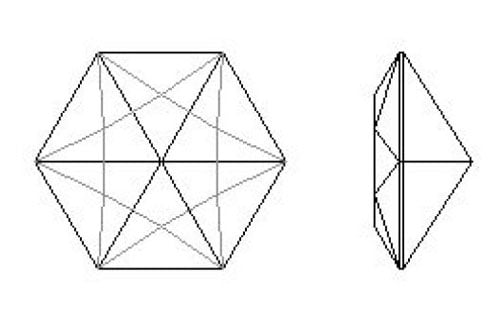
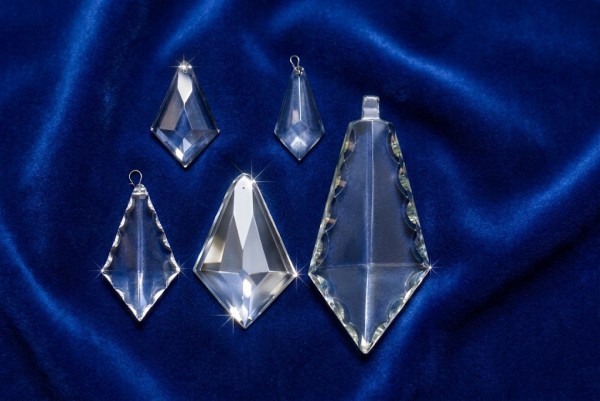
Kite Drop (also historically referred to as a Lozenge or Diamond Cut Prism), dating back to 18th and 19th century European lighting design, kite drops feature four distinct main angles, typically where the top angles extend longer than the bottom ones. Highly favoured in French Empire, Georgian, and Victorian lighting, their wide flat facets were cut specifically to catch light from central candles and refract sharp, brilliant beams outward. They were commonly used as accent drops along chandelier borders, sconces, and table candelabras.
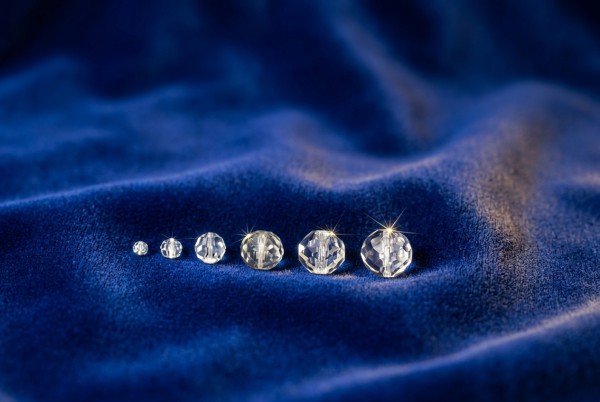
Faceted Crystal Bead also known as a Round Faceted Bead, Rondelle Bead, or Chandelier Chain Bead.
Dating back to the 17th century in Venetian and Bohemian glassmaking, faceted beads are among the oldest structural elements of crystal lighting. Unlike drops suspended from a single top hole, these beads feature a central channel drilled through the middle, allowing them to be threaded on wire pins or links. Designed with uniform diamond or geometric facets around their full circumference, they capture light from every angle as they rotate slightly on their strands. They serve as the fundamental building blocks for crystal garlands, drape swags, and beaded ropes, connecting larger pendeloques to chandelier frames across Baroque, Georgian, Victorian, and Art Deco styles.