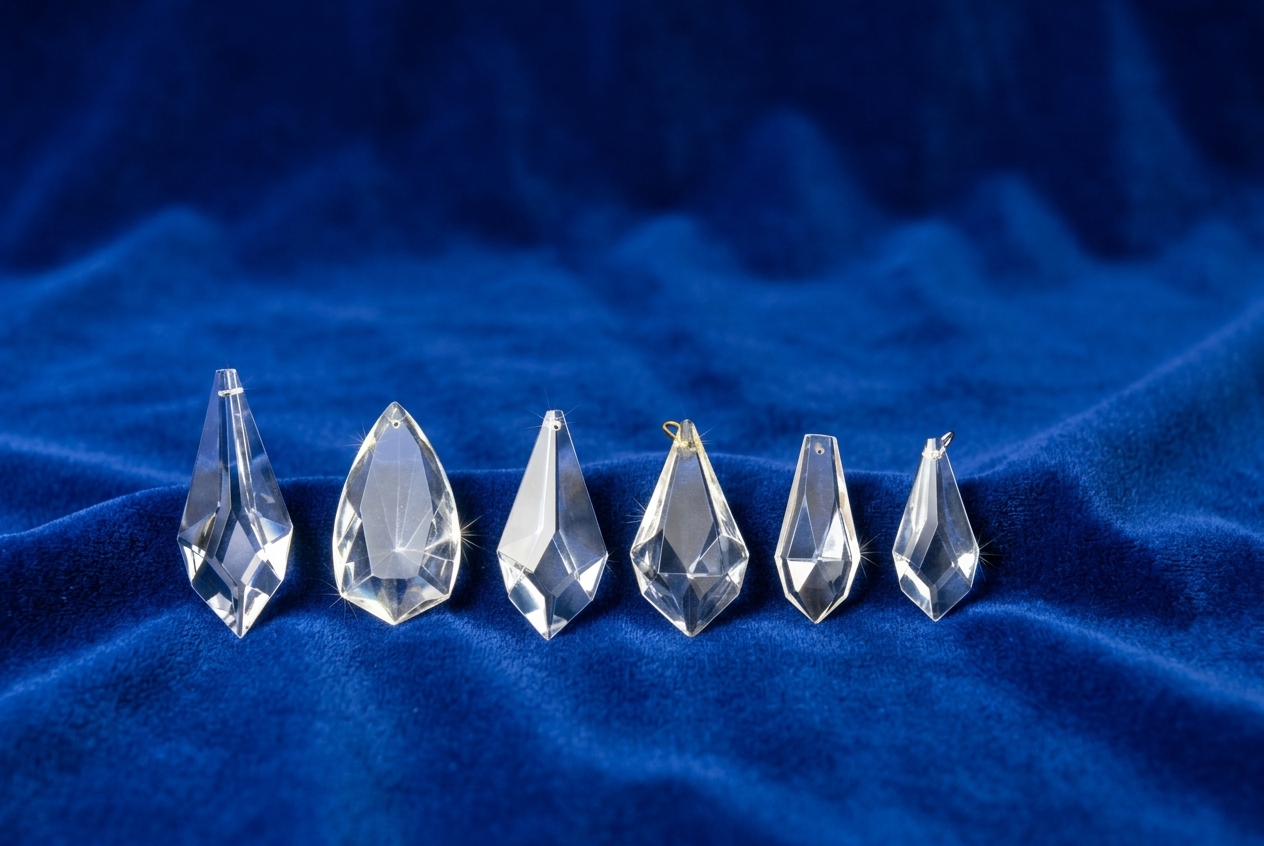
These chandelier drops are classic examples of “pointed pear” pendeloques, also known as “almond” drops or “tear drop” crystals. They are characterized by their symmetrical, teardrop-like shape that tapers to a definitive point at the bottom and has faceted surfaces. The flat upper hole allows them to be suspended, typically with a wire loop or metal pin. Their size often varies, and they are frequently used in graduated sequences. The facets are designed to catch and refract light, creating the sparkling effect desired in traditional chandelier designs.
These drops are intimately tied to the evolution of European chandeliers. While natural crystals like quartz were used in very early high-end lighting, the true explosion of these cut drops came with the development of high-quality lead glass, or “flint glass,” in the late 17th century, perfected by English glassmakers. This glass was much clearer and had a higher refractive index, meaning it could be cut and faceted to create brilliant light dispersion.
The “pointed pear” or “almond” shape gained immense popularity during the 18th century, particularly in French and English chandeliers of the Georgian and Rococo periods. Designers sought to create intricate, sparkling curtains of light, and these shaped drops were perfect for stringing together or using as terminal points on chandelier arms and borders. Their use continued through the 19th and 20th centuries and they remain a staple of traditional chandelier design to this day.